The Role of Tropical Forests in Carbon Sequestration
A literature-based assessment of tropical forests as carbon sinks and the cost of deforestation
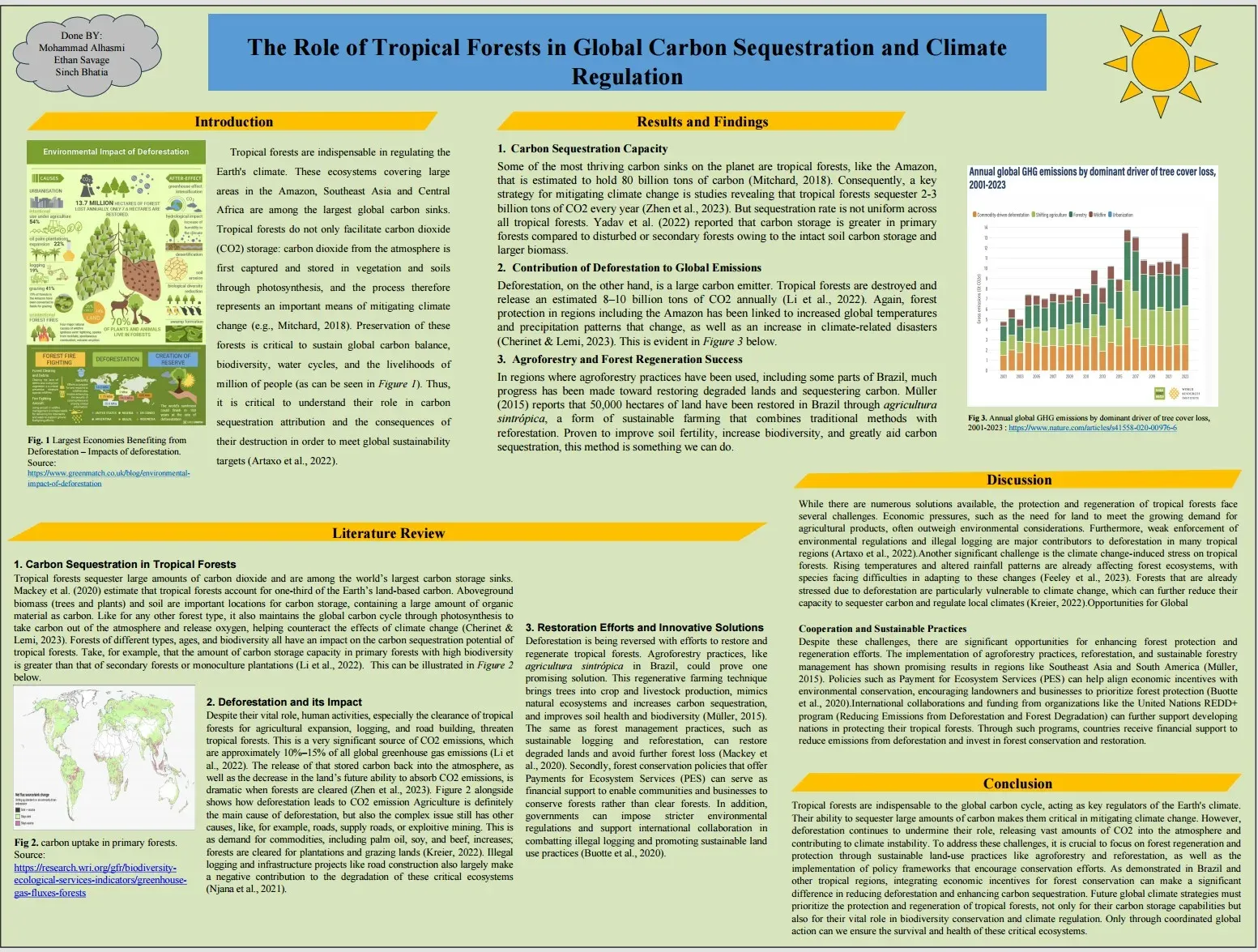
Intact tropical forests store roughly 200 to 300 tons of carbon per hectare, and clearing them turns that stored carbon into an estimated 8 to 10 billion tons of CO₂ emitted to the atmosphere every year.
Objective
Intact tropical forests store roughly 200 to 300 tons of carbon per hectare, and that number is the whole point. This project set out to quantify how much carbon tropical forests actually hold, what happens to it when those forests are cleared, and which conservation strategies hold up under the evidence. It ran as a personal research project inside ENV411 at the University of Toronto, paired with a group research poster co-authored with two classmates.
Approach
The individual paper is a structured literature synthesis, not a field study, and it’s framed that way. I pulled from peer-reviewed work (Mackey et al. 2020, Li et al. 2022, Yadav et al. 2022, Nunes et al. 2020, and others) plus remote-sensing and carbon-density datasets, then compared biomass estimates and soil carbon stocks across intact versus degraded forest. Three regions anchored the comparison: the Amazon Basin, Southeast Asia, and Central Africa. The point of comparing them was to show that carbon storage isn’t uniform, so conservation can’t be either.
Findings
The headline is the asymmetry. Old-growth Amazon forest can hold hundreds of tons of carbon per tree, and the Amazon as a whole is estimated to store around 80 billion tons. Tropical forests sequester an estimated 2 to 3 billion tons of CO₂ per year. Clearing them runs that in reverse: deforestation releases an estimated 8 to 10 billion tons of CO₂ annually and accounts for close to 10% of global emissions. Roughly 1.5 million hectares of Amazon forest are lost each year, much of it to cattle and soy. Southeast Asian forests, despite high biodiversity, store less carbon per hectare than the Amazon because of differences in species composition and soil. Restoration can claw some of it back: syntropic agriculture in Brazil has restored about 50,000 hectares.
Why it matters
A degraded forest doesn’t just stop absorbing carbon, it gives back what it already stored, and it loses the resilience to recover. That’s the feedback loop worth taking seriously. The paper lands on four grounded strategies (protected areas, sustainable land use like agroforestry and reduced-impact logging, local-community involvement, and international programs such as REDD), and it’s honest that weak enforcement and economic pressure are the real obstacles, not a shortage of good ideas.